How Google Ad campaigns get smarter over time
One of the strengths of digital marketing is its ability to improve or get “smarter” over time, but how does the Google Ads platform get smarter…

In 2019, Google announced a new way to measure integrated app and website data; Google Analytics 4.
With Google ending Universal Analytics (UA) this June, you may be receiving emails that it’s time to make the switch.
Here’s what you need to know:
It’s all about the perspective and the primary lenses we use to interpret data.
In the simplest of definitions, UA measured first by sessions, or ‘time spent viewing’ (my words, not Google’s words). GA4 measures everything by ‘events’, or ‘interactive moments’ (again, my description, not Google).
Though most of the information from UA can still be found on GA4, it differs greatly in HOW it was collected and collated, which in turn impacts how it informs us of your customers' behaviours.
UA’s primary focus on ‘views’ made tracking user flows across platforms difficult.
Now, with GA4, you can track both web and app data together in the same property, and can gain a fuller understanding of how your customers interact with both your app and website.
With this more holistic approach, you can understand the complete user journey throughout the sales funnel—from acquisition to conversion—enabling more in-depth reporting.
GA4 also has an array of new metrics including engaged sessions, engagement rate, and engagement time.
GA4 utilises a different data logic than UA, focussing on event-based data that processes every user interaction as an ‘event’, rather than utilising session-based data where users are grouped by time frame.
Again, this event-based method enables better path and cross-platform analysis. It also enables GA4 to better predict how users behave, leading us to the next point:
GA4 now uses Artificial Intelligence (AI) and Machine Learning (ML) to gauge and predict user interactions. The goal of this predictive analysis is to help brands make proactive decisions based on the future, rather than reactive decisions based on past data.
These AI metrics include purchase probability, churn probability and revenue prediction. These metrics can form an audience for specific Google Ad targeting.
With privacy laws and policies becoming increasingly stringent, GA4 has also boosted focus on protecting user data.
While UA has various privacy controls available, GA4 has ‘privacy-first tracking’ with more comprehensive data collection and usage settings. It also no longer stores IP addresses that pinpoint a person’s exact location and device.
These new privacy controls have been put in place to meet the increasing expectations for the user or customer to be in control of their own data and privacy.
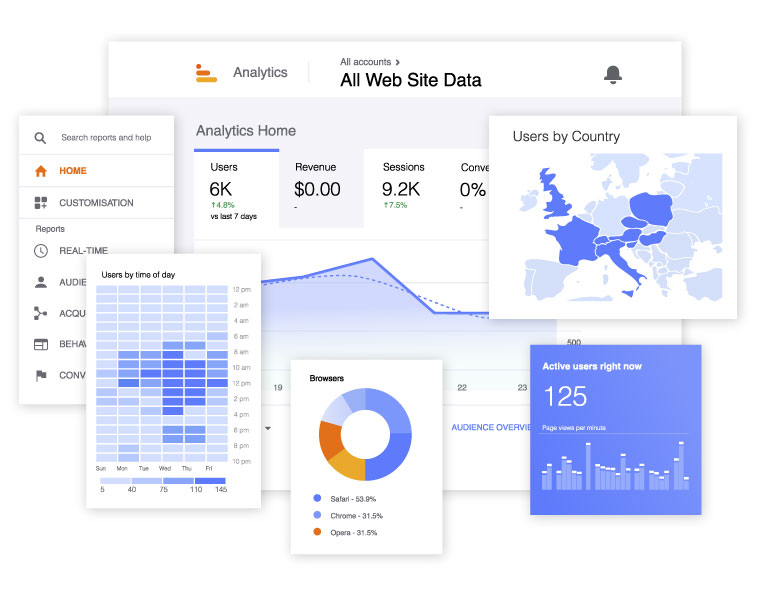
The most obvious change with GA4 is the new-look dashboard.
While the new dashboard may take some getting used to, it has been designed to give greater insight into the whole customer experience, as well as some attempt to streamline the reporting and interpretation processes. And though it may seem clunky while fitting in GA4’s new features, like predictive insights.

While GA4 is a powerful analytics tool, it will take marketers time to get used to it. Some features and reports that we’ve gotten used to in UA have changed, moved, or are no longer.
The other downside is that data does not transfer from UA to GA4. That means, if you switch to GA4 right on the deadline, you will only have a days worth of data to analyse. So, if you haven’t already, we suggest you may the switch sooner rather than later so you’re not entirely starting from scratch once UA turns off.

UA users have until the end of June 2023 to make the switch.
For our clients, we’ve already set up your GA4 account a year ago to ensure you have at least a years worth of data to analyse and teach the new predictive analysis features.
If you haven’t switched to GA4, time is running out.
Contact your marketing partner today.